Science vs. Everything Else
Thursday, January 21st, 2016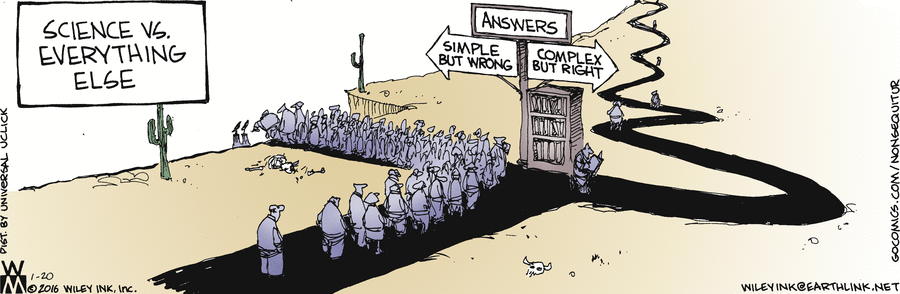
For every complex problem there is an answer that is clear, simple, and wrong. H. L. Mencken
Once again, Wiley Miller gets it perfectly right.
| Ralph Waldo Emerson |
For every complex problem there is an answer that is clear, simple, and wrong. H. L. Mencken
Once again, Wiley Miller gets it perfectly right.

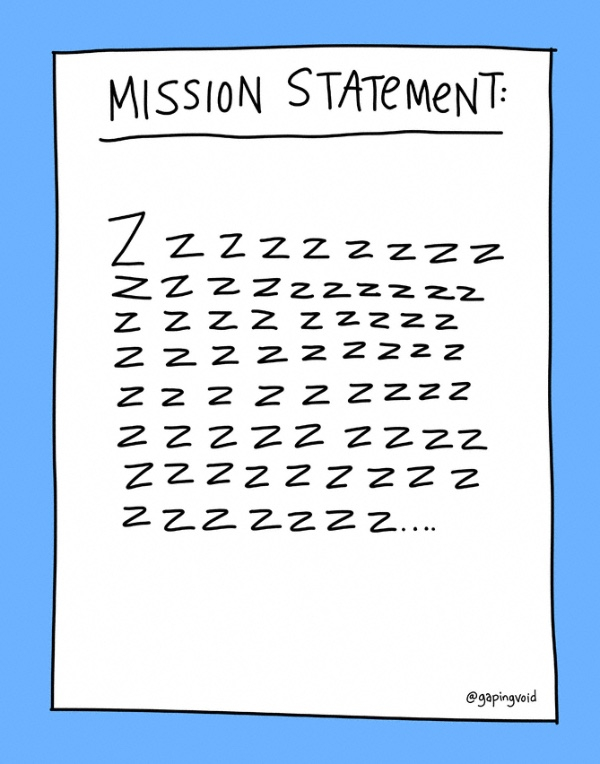
When you wake up in the morning and think about what you’re going to fight like hell for, it’s probably not going to sound like a typical corporate mission statement.
We’re humans. We need to feel inspired. Every. Frickin’. Day.
The companies who understand the humanity of business – those are the ones you’ll fight like hell for.
It’s pretty simple. If you want a team dedicated to making incredible things happen, give them a reason.
[Note to most CEO’s] If it’s only money, it’s probably not going to sustain the business… and you won’t meet targets for very long.
The solution here is often this misguided trend towards social entrepreneurism.
That businesses have to be about ‘doing good’ as the outcome. The truth is, businesses need to make money to survive. We all get that. Let’s not lie.
And we can be so much more. Read “He Who Cares Wins”, by our good friend David Jones (@davidjonesOYW).
The point is, usual corporate core values — “Integrity, passion, community, customers, etc.” are meaningless to most of your employees and customers. And if your mission statement is corporate speak as well, you’ve lost us. And you need us. Your employees, customers and prospects. Win us over for God’s sake.
Be driven by your core. And a real, deep connection to your people. That’s how mission and core values should be: the values, at our core, that drive our mission.
In many ways the role of business has changed, and it requires a re-think.
How’s your mission statement feeling right about now?
Image and text by @gapingvoid
In his book, The Great Degeneration, Niall Ferguson writes about how membership to civil organizations has declined significantly in the last hundred years, both in the USA and the UK. By civil organizations, he means everything from charities, to museums, to Girl Scouts, to the Rotary Club.
From my end, it’s not hard to see why this decline has happened. We spend so much time at work now (including the commute), so we increasingly have to get our sense of civil participation at the office, not outside it.
Which means the community focus of our workplace, i.e. our company’s place in the community and or our place within that, is an increasingly large part of our self-identity.

So when they talk about how Millennials are suddenly needing to find so much "meaning" at work, a lot of that is about community context. They need to feel like what they do is relevant to the world they aspire to live in.
If you work at a large institution with deep roots in the community, like University of Miami (see blurb below), this is all pretty obvious.
It’s less obvious if your company is just driven by making money. Trust me, it’s not. There are other drivers also at work.
Just ask any Millennial…
Image and text by @gapingvoid
Christian Garcia, Associate Dean & Executive Director of the Toppel Career Center, created this video discussing his journey in creating an immersive, engaging environment for students, faculty and employers. Christian discusses his thoughts on how to imbue environment with meaning and creating spaces that connect people deeply.
Read more from the article in InsideUm Magazine.
Love this comment by "retired@33" to an article that explains the skepticism about Theranos business model titled When startups go sour – what happens when unicorns run into trouble?
Don’t worry. All we have to do is keep saying "innovate", "future" and "agile" and the internet will magically disrupt us into a 21st century utopia where start-ups are mysteriously valued at billions without actually having ever turned a profit, and people will be able to spend on "services" even though they don’t have jobs any more.

Little comment needed… this cheerful lady will probably have many people to tell what she sees to. All others are broadcasting… mainly for themselves only!
Brian Solis (@briansolis) nails it in a slightly different way:
This precious photo was shared by Wayne Dahlberg, http://t.co/piXZ6OZkwl – I edited it to make a point  pic.twitter.com/Ni3JhYeT6w
— Brian Solis (@briansolis) October 8, 2015
Having spent a good part of last week at the Dpharm Disruptive Innovations to Advance Clinical Trials Conference, in Boston, we came away with some insights about innovation – a subject that we’ve given a lot of thought to over the years but is endlessly fascinating.
More than ever, we believe that true innovation is first and foremost a cultural issue. Most big organizations are so invested in minimizing risk, that truly disruptive ideas can never take hold.
Strategically, pharma should build completely separate incubator type functions that are independent from the structure and cultural baggage of the parent. Then, integrate the success of those businesses back into the mother ship. Probably with the entrepreneurs as leaders (an idea certain to make most execs not want to innovate).
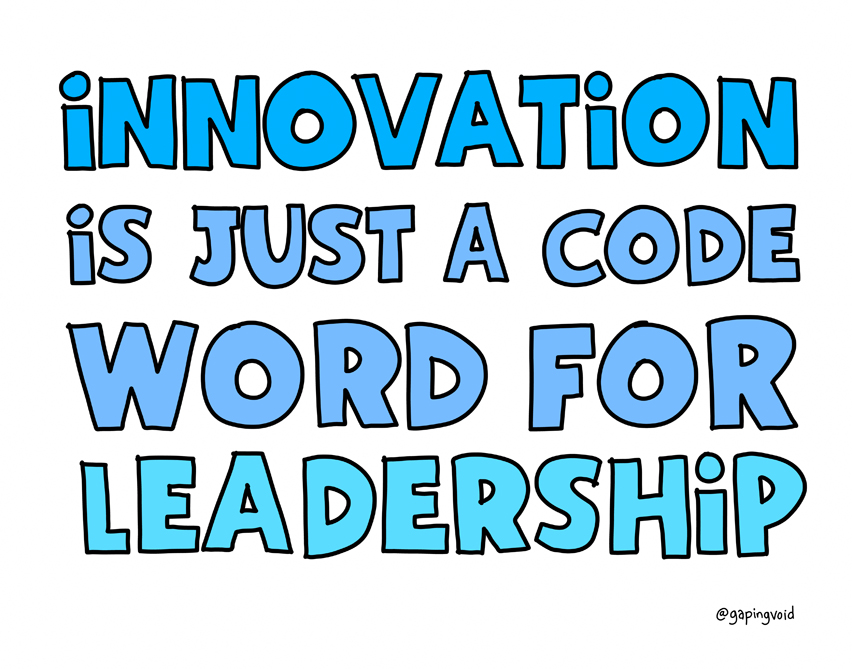
Like the image above says, Innovation is really about leadership. An acceptance of risk, and the personalities that are actually disruptive to the status quo. Learning to live with the idea that if you aren’t feeling uncomfortable, then innovation isn’t happening.
Which leads to a related thought. I couldn’t help but compare this to some work that we’re doing for Peter Lee, Head of Microsoft Research who spoke eloquently about the role of research and innovators in this video. Peter’s ideas about innovation apply to all industries, but pharma seems to be so risk adverse that it feels like innovation will only come in the vanilla, good tasting variety.
We also published a mini-book called "Disrupting R&D, 20 Ideas to Foster Innovation and Disruption in Drug Development" for the conference attendees. The book was written for the pharma industry, but it applies to all businesses. It’s a ten minute read. Feel free to download and share.
Image and text by @gapingvoid
Work is solving problems. The industrial approach was detached from customers and there are many problems without a mass-market solution
— Esko Kilpi (@EskoKilpi) September 1, 2015
The new rules
Before and now
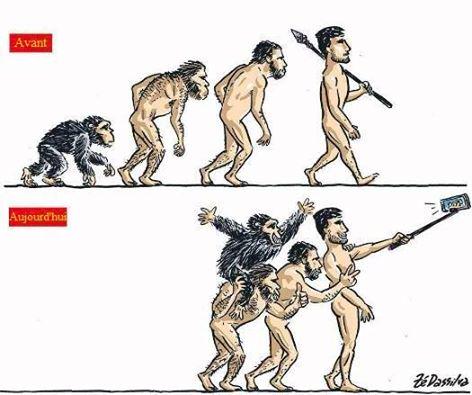
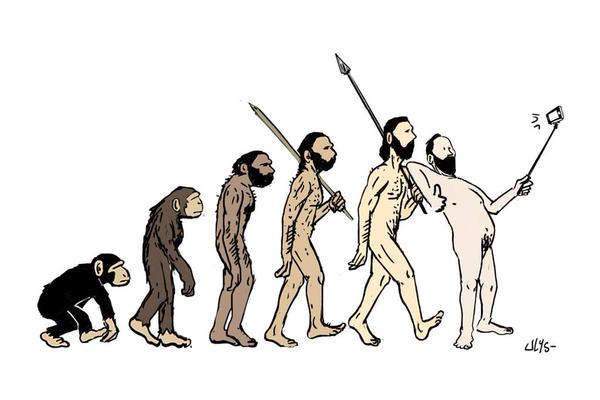
Evolution stops
It is a 10 by 3 meters bramble branches wall. A tightly woven set of thorns, an impenetrable and intimidating vegetal universe.
I attacked it like a giant Mikado game, initially securing a corridor to the roots, then heading laterally. It is a game one seldom wins unharmed; the thorns come through the thickest gloves and there is always a rogue creeper to lash your face when you are getting rid of its neighbour.
Léo is 9 years old. He first hits the wall with a rake, to "bust it all" then, considering the lack of efficiency of this frontal burst of energy, he decides to pull branches in order to ease their removing. Finally, when I have a break, he wears the heavy gloves, get the branch clippers and gets himself immersed in the vegetal mass to gain access to its roots.
Step by step he became aware of the way a complex system should be addressed. The wall is condemned.
C’est un mur de ronces de dix mètres de long et de près de trois mètre de haut. Un entrelacs d’épines, un univers impénétrable et intimidant.
Je l’ai attaqué comme un Mikado géant, sécurisant initialement un couloir d’accès aux racines, puis progressant latéralement. On ne sort jamais complètement indemne d’une telle confrontation ; les épines traversent les gants les plus épais et il y toujours une liane plus retorse pour vous cingler le visage lorsqu’on dégage sa voisine.
Léo a 9 ans. Il commence par taper sur le mur à grands coups de râteau, « pour tout dégommer » puis, constatant le peu d’efficacité de cette débauche d’énergie frontale, il décide de tirer les ronces pour en faciliter le dégagement. Enfin, au moment où je fais une pause, il enfile les gants de travail, se saisit de la cisaille et s’immerge dans la masse végétale pour accéder aux racines.
Il a compris étape par étape comment gérer un système complexe ; le mur est condamné.
Le septième cahier de veille de la Fondation Télécom a pour objectif de faire le point sur la thématique de l’homme augmenté et les travaux de recherche qui y sont associés.
Une archive est disponible en cliquant sur l’image.
Went to the Apple Store today fully intending to buy an Apple Watch. Because futurists gotta fute.
Weirdly, Paul McDermott seemed to be trying to do the same thing at the same time in the same store.
So there’s that.
When a helpful Apple Store person came along to help me, we found the right watch, he took it from the drawer, and fastened it to me…
I was immediately and deeply revolted by the experience. Actually freaking out a bit.
I was polite enough as he went through the demo and the Apple Watch did its taptic thing – which is also weird and invasive. And waited.
And at the first opportunity, took the Apple Watch off, handed it back to him, and very nearly ran out of the store.
I was very confused by my reaction. It made no sense. First time I’ve ever had that reaction to any sort of Apple product.
After some time and reflection, it became very clear that Apple Watch demands an intimate relationship from the moment you strap it on.
That seems to be just fine for a lot of folks. For me it’s invasive and not at all a pleasant experience. Rather the opposite.
I don’t think it was future shock. That felt a lot more like an uninvited and altogether too intimate guest.
Strapped to my body.
This isn’t about any watch: when I borrowed @johnteeee‘s LG smartwatch for ‘old man yells at cloud’ last week, I really enjoyed it.
I almost didn’t want to give it back and would have bought one except Apple won’t let it play with iOS. Obvs.
The point – with a product so consciously intimate that it can transmit SOMEONE ELSE’S HEARTBEAT – is that introductions matter. A lot.
The Apple Store is not the place to ‘get to know and get comfortable with’ an Apple Watch. It just feels hysterically menacing, somehow.
In the end, this is more about my own psychological mechanics, and where my own boundaries between self and other lie. Obvs.
From @mpesce‘s Twitter feed.
Change isn’t a plan.
It’s not a list of things to do.
It isn’t logical.
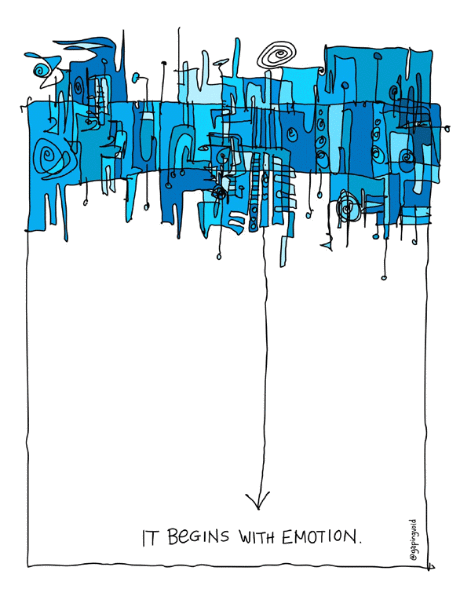
Change is a series of emotions.
It starts in your heart, when you feel the need to go after something better.
Change is the fear things won’t work out. The frustration when they start to fall apart, the doubt that creeps in when you start to wonder if you made the right choice.
Change is the feeling that, no, dammit, I’ve got to see this though.
In the end, change is the profound feeling of satisfaction that you get from walking through the fire and coming out the other side.
Perhaps not entirely unscathed, but perhaps all the better for the scars.
Image and text by @gapingvoid
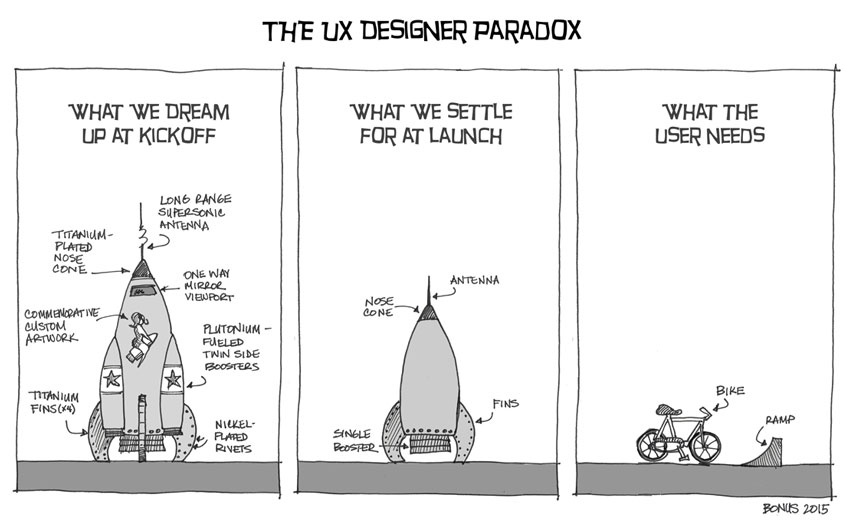
Where user experience designers start and where they finish are rarely the same place. However, as long as they keep the user in their considerations and iterations, UXers can at least ensure they end up in the right place.
A comic by Brady Bonus (@bradybonus)
When you do work that matters, the crowd will call you a fool.
If you do something remarkable, something new and something important, not everyone will understand it (at first). Your work is for someone, not everyone.
Unless you’re surrounded only by someones, you will almost certainly encounter everyone. And when you do, they will jeer.
That’s how you’ll know you might be onto something.
From Seth Godin (@ThisIsSethsBlog) on May 24, 2015
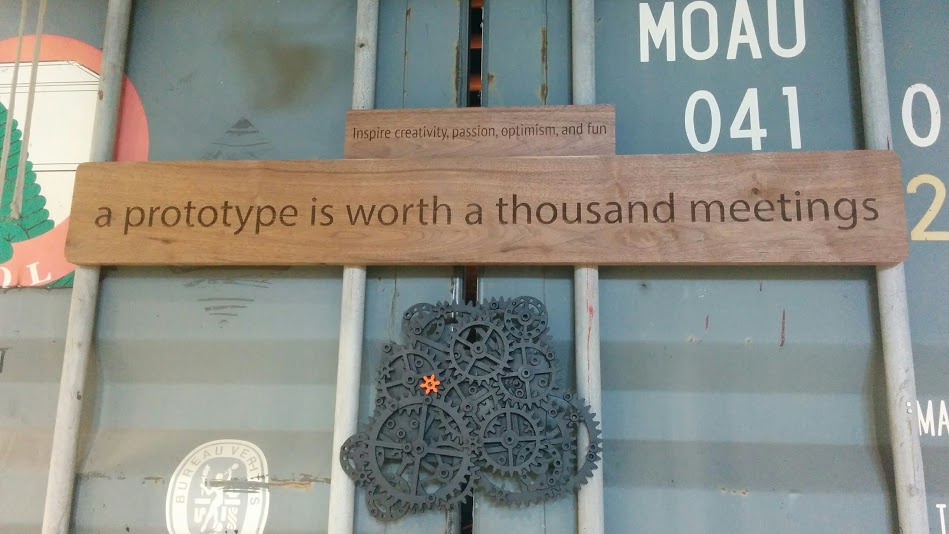
Motto on the wall at +1stbuild at the #HacktheHome hackathon, picture by Dustin Kirkland (@dustinkirkland)
Welcome to the human condition: we want everything to change; yet we still want to be able to carry the old baggage around with us.
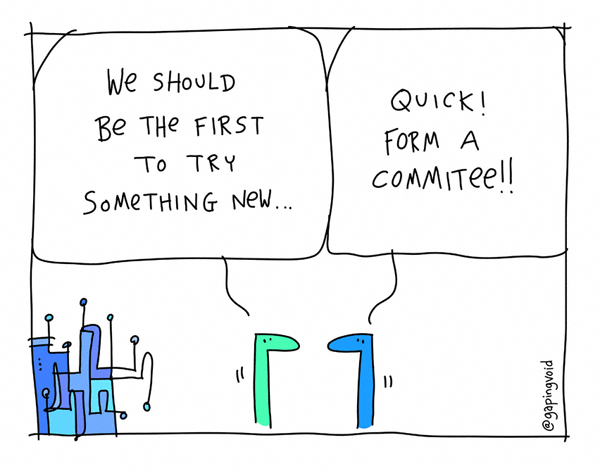
i.e. We say we want to change everything from the ground up – except for all the old habits that dominate our lives completely.
St. Augustine had a prayer about this: “O Lord, make me chaste. Just not yet.”
Any leader in business is going to run into this with his or her people, from the beginning, every day, forever and ever. It isn’t ever going away.
It’s like the Higgs Field of humanity; it’s just there.
Image and text by @gapingvoid